The Cosmic Assassins: How Supermassive Black Holes Quietly Rewrite the Universe
If you take a step back and think about the sheer audacity of the universe, few things rival the relationship between a supermassive black hole and its host galaxy. Personally, I think we tend to look at space through too narrow of a lens—focusing either on the microscopic mechanics of stars or the macro-scale architecture of galaxy clusters. But what happens in the messy, invisible space between those scales is where the real drama unfolds. Recent findings have finally started solving a decades-old astrophysical mystery: why certain massive galaxies look like cosmic ghost towns, stripped of the raw ingredients needed to forge new stars. What makes this particularly fascinating is the culprit. We are talking about invisible, infinitely dense gravitational pits that manage to reach out across hundreds of thousands of light-years to choke the life out of entire star systems.
The David and Goliath Paradox of the Cosmos
One thing that immediately stands out when looking at these galactic engines is the absurd scale disparity. From my perspective, it defies everyday intuition that an object taking up roughly the same spatial footprint as our solar system can dictate the fate of a swirling metropolis containing a hundred billion suns.
- A supermassive black hole is a localized singularity tucked safely into the core of a galaxy.
- The surrounding circumgalactic medium—a colossal cocoon of gas and dust—spans vast expanses far beyond the visible stellar disk.
- Yet, somehow, the tiny engine at the center manages to punch way above its weight class.
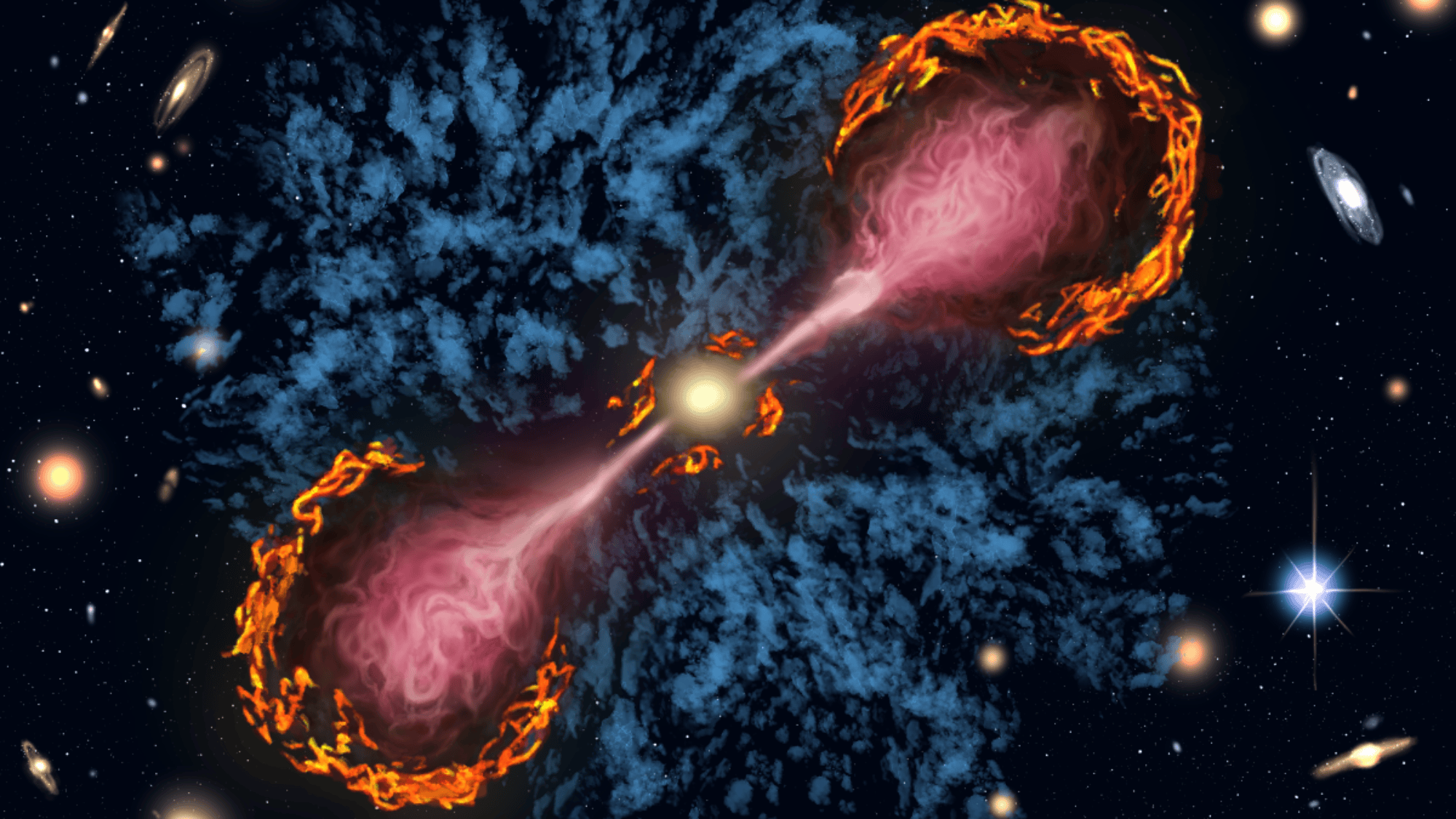
What many people don't realize is that these black holes aren't just passive vacuum cleaners swallowing stray matter. When they feed, they turn into ferocious accelerators, shooting out high-energy plasma jets that slice straight through the heart of the galaxy. In my opinion, this challenges our human bias toward size. We assume that massive structures must be governed by equally massive forces, but the universe operates on leverage. A tiny, highly active valve can control the flow of an entire river, and a microscopic black hole can regulate the temperature of a cosmic empire.
Precision Warfare on a Galactic Scale
What this really suggests is that cosmic regulation isn't some blunt, uniform blanket of energy suffocating everything in sight. Instead, recent data combining sky surveys like DESI and LOFAR reveals that these plasma jets act like scalpel strikes rather than shotgun blasts.
A detail that I find especially interesting is where these jets pack the heaviest punch. They don't just dissipate immediately around the core; they travel outward, interacting selectively with gas clumps and lighting up ionized trails until they reach the absolute periphery—the outer edges of the circumgalactic medium itself. This is where the true strangeness of the mechanism lies. By delivering their kinetic punch precisely at the outer frontiers where new star-forming material tries to condense, the jets effectively slam the door on future growth.
Personally, I think this paints a picture of galaxies not as static objects, but as self-regulating ecosystems engaged in a permanent, delicate tug-of-war. The black hole acts as an internal thermostat, kicking on violently whenever the galaxy threatens to get too prolific with its star-making.
Connecting the Dots of Cosmic Evolution
This whole dynamic forces us to rethink what it means for a galaxy to "live" or "die." We tend to romanticize star birth as an unmitigated good—a brilliant burst of creation lighting up the dark. But if every galaxy kept churning out stars indefinitely, the universe would run out of fuel far too quickly, descending into a chaotic mess of burnt-out cinders.
This raises a deeper question about the timeline of our universe: are black holes the ultimate villains of cosmic history, or are they the necessary stabilizing force that prevents galaxies from tearing themselves apart through runaway growth? From my perspective, they are both. They are the executioners of potential, yet without them, the grand architecture of the cosmos we observe today wouldn't exist. When you trace the thread from a feeding black hole millions of light-years away right down to the quiet persistence of our own corner of space, you realize just how intimately connected everything is. The next time you look up at the night sky, remember that the quietest galaxies aren't peaceful by accident—they are living in the shadow of a master regulator that knows exactly when to pull the plug.